
Manufacturing
Optimize production, strengthen supply chains, and drive predictive operations.
Explore IndustryThe digital age has landed in the healthcare space in splendid style. It streamlines medical processes, but it also retains the ability to improve patient outco...
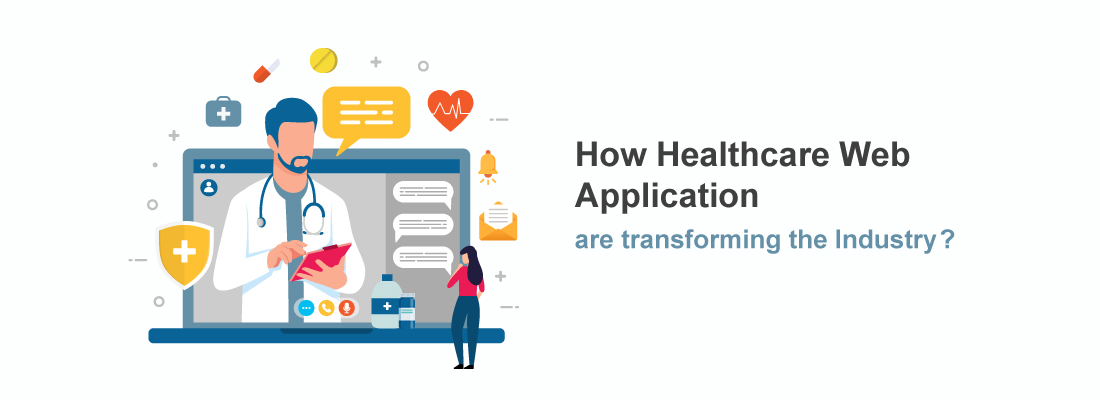
The digital age has landed in the healthcare space in splendid style.
It streamlines medical processes, but it also retains the ability to improve patient outcomes significantly.
Health data availability is enhanced, remote health delivery is improved, medication errors are minimized, expenditures are reduced, communication is improved – and the list goes on and on.
The creation of healthcare mobile apps is now essential for boosting patient satisfaction and revenue.
In this blog, we will explore the different types of healthcare web applications, along with their benefits.
This blog will give you useful insights into the world of healthcare applications whether you're a healthcare professional, a patient, or a tech enthusiast.

A healthcare web application is a piece of software created to help patients, healthcare workers, or other people in managing and maintain their health.
It can operate independently or be incorporated into a bigger system. Applications for healthcare can be used for a number of things, including:
Applications for the healthcare industry are frequently created to enhance patient outcomes, save costs, and improve healthcare delivery.
These may be accessed via laptops, tablets, or mobile devices, making it simpler for people to maintain their health while on the go.
The main obstacle for patients who seek out healthcare has always been the concern of the costs involved.
With the development of healthcare web applications, it is now simpler for patients to compare the prices of various providers and select a cost-effective choice.
The next main benefit is easily accessible to patient engagement systems to provide intensive care on time for patients.

With the commencement of the COVID-19 pandemic, it was realized quickly that a remote health monitoring system is essential to patient health.
Even though health systems were progressively seeking out services for developing mobile apps, their potential was only realized during the pandemic.
With the advancement of mobile health, there are countless possibilities, from simple consultations to medication reminders and general wellness.
Healthcare app development has become increasingly acknowledged as a crucial element for healthcare providers, offering a wide range of options.
With the recent advances in technology towards healthcare application development, healthcare apps for patients are empowered to produce better care.
Furthermore, mobile healthcare applications for patients can now assist doctors with diagnostic tests through extremely effective data analysis.
Through mobile medical application development, healthcare apps provide a variety of possibilities for health facilities, doctors, and patients that were previously thought impossible.
Healthcare web development enables patients to obtain care with only a few clicks, regardless of their location or the time of day.
The advancement of healthcare software has also been shown to reduce diagnostic errors.
Using thorough records, patient data analysis and management, and individualized care alternatives, doctors can manage their patients with greater accuracy.
Patients are empowered to maintain a healthy lifestyle.
Digital transformation guarantees that healthcare and medical apps benefit patients and doctors.
Even though creating a healthcare mobile application takes a lot of time and money, the advantages are worthwhile:
Enhanced doctor-patient communication;
Superior-quality care;
Better equipment management and medical service;
Accessible healthcare and medical data;
Assist with accurate diagnosis;
On-demand healthcare;
The cost-efficient way for healthcare providers;
Acts as a remote virtual medical assistant;
Secure payments.
To improve patient care and physician efficiency, healthcare organizations should discard their outdated practices and switch to cutting-edge E-health technologies.
The healthcare sector uses a wide range of software to assist in managing patient care, medical records, and other crucial functions.
These are just a few illustrations of the various kinds of software that are employed in the healthcare sector.
Several specialist software options, such as patient portal software, medical imaging software, and others, are employed for particular tasks and requirements.
The popularity of healthcare applications has grown over the past few years as a result of the development of mobile technology and the demand for healthcare solutions that are more effective and efficient.
They are being used by patients, health professionals, and other stakeholders in the healthcare system to boost care delivery and improve patient engagement.
Since Yugasa Software Labs has a wealth of experience creating healthcare apps, we are well-versed in how to create HIPAA-compliant software from the research phase to a finished solution that is ready for launch.
If you're seeking a healthcare app development firm or require any project-related advice from experts, what should you do? Reach out to us; we'll be pleased to assist you.
Read More: WHAT IMPACT DO MOBILE APPS HAVE ON THE HEALTHCARE INDUSTRY?